• Art
  • Design
  • Blog
  • About
  • Shop
Menu

Reagan Charles Cook

  • Art
  • Design
  • Blog
  • About
  • Shop
 
 
Categories
  • History 20
  • Humanity 20
  • Nature 16
  • Politics 13
  • Money 12
  • Geography 11
  • Numbers 11
  • Death 10
  • Violence 10
  • Religion 7
  • Art 6
  • Science 6
  • Design 5
  • Food 5
  • My Life 4
  • Film 3
  • Fashion 2
  • Music 2
  • Sex 2
  • Sports 2
  • Writing 1
spanish-fly.jpg

What's the Deal with Spanish Fly?

March 4, 2015

The Spanish fly is actually an emerald-green beetle, Lytta vesicatoria, belonging to the blister beetle family. (Meloidae). The insect's juice, terpenoid cantharidin, is a toxic blistering agent with poisonous properties comparable in degree to that of the most violent poisons.

However, despite the inherent danger, it has a legendary reputation as an aphrodisiac. As it passes through the body, cantharidin irritates the genitals resulting in increased blood flow that can mimic the engorgement that occurs with sexual excitement.

 For this reason, various preparations of desiccated Spanish flies have been used as some of the world’s oldest love potions, with a reputation dating back to the early western Mediterranean classical civilizations.

The ease of toxic overdose makes this highly dangerous, so the sale of real Spanish Fly has been made illegal in most countries. 

In Death, Sex, Nature
blimp.jpg

The Rarest Job in the World

February 3, 2015

Blimp pilots are an uncommon breed.  There are less than 30 operational blimps worldwide, and in the United States, only 24 people who are officially licensed to fly them.

Note: The image above depicts German Zeppelin LZ 129 Hindenburg on arrival at Lakehurst, New Jersey, after its inaugural flight from Friedrichshafen, Germany, on the early morning of 9 May 1936.


In Numbers, Humanity
fat.jpg

Cutting A Fat Person in Half

January 3, 2015

This MRI scan shows the difference between a healthy (120 pound) and obese (250 pound) woman.  You can see where the strain is put on an obese body. Excess fat not only encases the woman’s waistline but also wraps around her heart, liver, lungs and tissues.  

In Death, Food, Humanity, Science
Chimp-Head.jpg

Why Aren't You Eating Me?

May 3, 2014

Despite their aggressive nature, large groups of Homo Sapiens have proven capable of successful cooperation when united by the belief in a common myth. All recorded examples of large-scale collaboration in the species – from the formation of tribes, to the design of religions, and economies - have been based on common myths that only exist in the group's collective imagination.

The image above is a photograph of a hairless chimpanzee taken by Tim Flach

In History, Humanity, Nature, Politics, Religion, Violence
tumblr_nrn301Yt7H1qarfgyo1_1280.png

How Many Chickens Are There?

April 3, 2014

Noah Strycker, the author of “The Thing With Feathers,” a book about birds, recently told an interviewer that the domestic chicken “has more numbers” than any other vertebrate.

He put the planetary figure at 24 billion - or 3.5 chickens for every person.

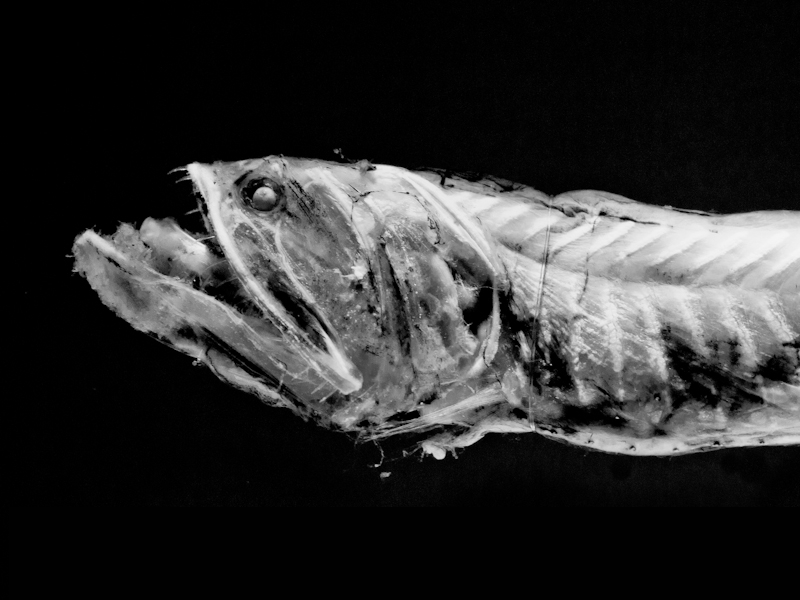
While that’s a big number, it’s nowhere close to the record. In terms of total population, the winner is a bristlemouth  — a fish that lives in the middle depths of the world’s oceans. 

Biologists put the global figure for bristlemouths at hundreds of trillions — perhaps quadrillions or thousands of trillions.

“They’re everywhere,” Bruce H. Robison, a senior marine biologist at the Monterey Bay Aquarium Research Institute in California, said of the bony little fish. “Everybody agrees. It’s the most abundant on the planet.”

It makes sense that the winner is a fish. Habitats on land — rain forests, steppes, woodlands, deserts, alpine meadows, all well explored over the centuries — make up less than 1 percent of the planet’s biosphere. The band of life is narrow. Fertile soil goes down only a few feet, and even the tallest trees stretch up only a few hundred feet. 

Water, however, is a different story. It covers more than 70 percent of the earth’s surface and goes down miles. Scientists put the ocean’s share of the biosphere at more than 99 percent. 

From William H. Broad’s ‘An Ocean Mystery in the Trillions’

← Newer Posts Older Posts →

Looking for something special? Click here to explore the archive

® Reagan Charles Cook. All Rights Reserved, 2020